

A question is circulating in rooms full of smart, well-resourced, well-intentioned people right now:
If intelligence becomes abundant, what becomes precious?
At first I just thought it was the wrong question. But after spending time with it, I’ve come to believe the problem isn’t the question. The problem is the question rests upon an unverified premise: that what’s becoming abundant is actually intelligence in the first place.
It isn’t. And the gap between what’s actually getting cheap and what we’re calling it is not a technicality. It’s where the real work lives.
The Word Doing All the Work
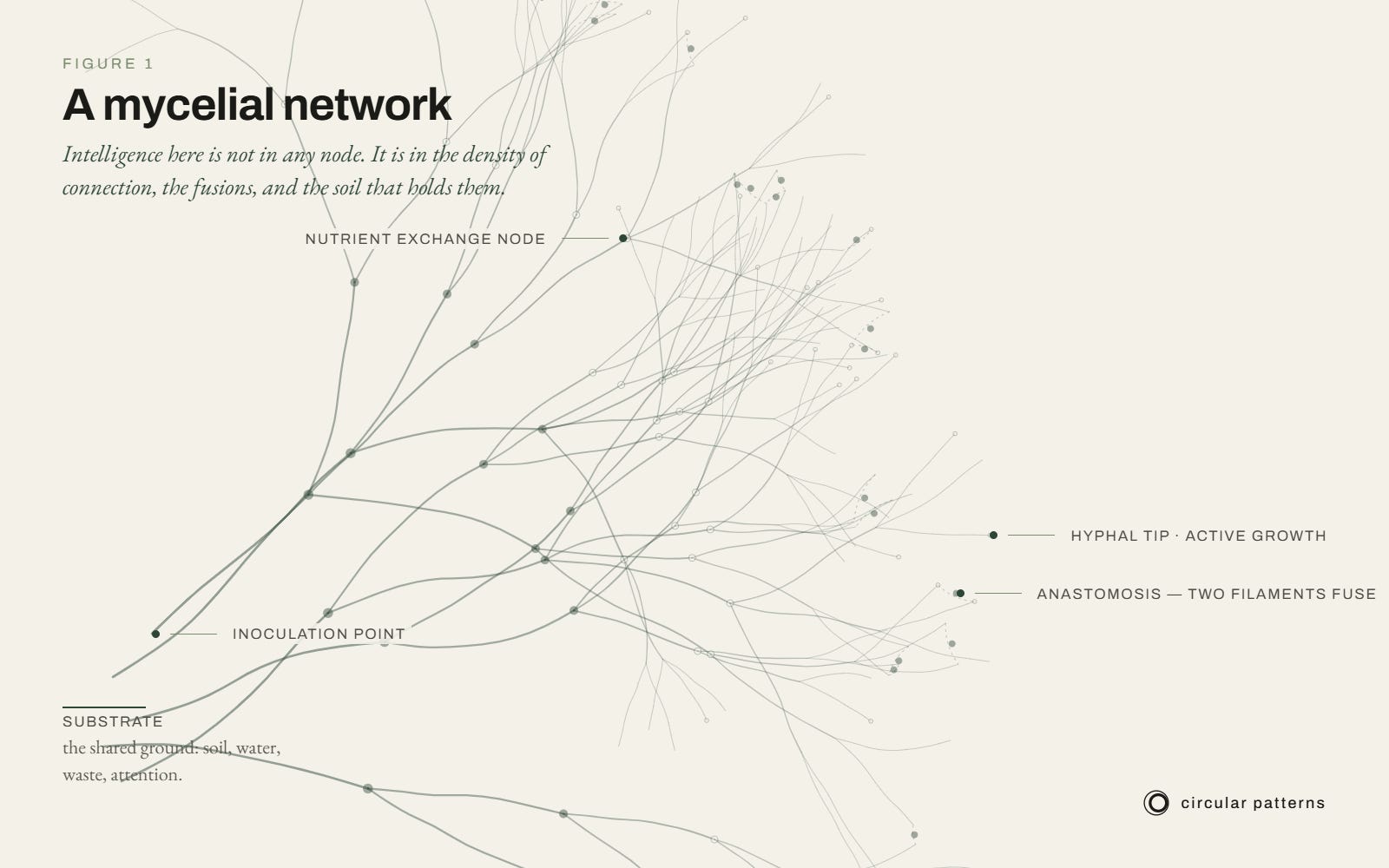
Ask a mycorrhizal network to solve a math problem and it will fail every test a language model would ace. But ask which stressed seedling in the shade needs carbon this spring, and the forest already knows. It is already moving sugar through fungal threads to the exact roots that need it, without ever representing the problem to itself as a problem. That’s not a weaker version of what AI does. It’s a different operation entirely: not a model of the flow, but the flow itself, running in real soil, at real metabolic cost, built over real decades.
What’s actually becoming abundant is the first kind of intelligence — the kind that works by abstraction. Pull a pattern out of its context, represent it symbolically, and it becomes transferable: copyable to a thousand servers at once, available to anyone with no gatekeeper standing in the way. That’s a genuine, historic shift, on the order of what electricity did to mechanical power. I’m not arguing otherwise.
What isn’t becoming abundant — what can’t, structurally — is the second kind: mycelial reciprocity, a watershed’s exact seasonal timing, the decades of soil chemistry under my own front yard, an octopus unscrewing a jar lid to get at the food inside, using arms that carry most of its neurons and do real problem-solving on their own rather than waiting on orders from a central brain. This kind of intelligence doesn’t represent anything. The intelligence is the material relationship. You can’t extract it without ending it, and you can’t copy it to another forest without regrowing the actual fungus, the actual roots, the actual years.
Calling this abstraction “intelligence becoming abundant” quietly does something worth naming out loud: it promotes one narrow, ownable, scalable operation to stand in for intelligence in general — while the intelligence keeping 8.3 billion of us alive is not represented and, worse, is being extracted and depleted more rapidly in the name of making abstraction abundant.
The Same Old Trick, Running Faster
I’ve spent three years studying why modern culture keeps making this exact move, and it isn’t new. Status in domination culture has always run on wealth, power, and fame — accumulated by a single node, at the expense of an out-group, with the externalities left off the ledger. It’s a node-based value system: worth gets calculated from what one entity possesses, never from the quality of what runs between entities.
Abundant abstraction doesn’t sit outside that logic. It runs inside it, and it speeds it up. Better targeting. Cheaper extraction. Data centers depleting a town’s water and grid capacity to rent out synthetic cognition by the token, while the humans downstream absorb the cost. Abundant abstraction has no preference for what it’s pointed at — it will optimize a cure for a disease and a more addictive slot machine with identical enthusiasm. It doesn’t correct bad values. It executes them, faster, at scale, with better aim.
So if nothing about the underlying status economy changes, abundant abstraction masquerading as intelligence isn’t a liberation. It’s domination culture’s endgame, arriving on a faster clock.
What’s Precious Is Ancient
Nora Bateson and a long line of systems thinkers before her have been trying to tell modern culture something it keeps failing to hear: the meaningful unit was never the node. It’s the relationship between nodes — the pattern connecting a fungus to a root to a canopy to a rain cycle. Node-based status logic can’t see that pattern, because relationships and the flows between nodes can’t be owned by an entity and displayed on a balance sheet.
Here’s the part I want to emphasize and shout from the rooftops: the intelligence of mycelial networks, octopus cognition, and the water and nutrient cycles isn’t a metaphor for what a caring society should look like. It’s the empirical, billion-year-tested version of it — already running on reciprocity instead of accumulation, redundancy instead of efficiency, seasonal timing instead of maximization. Domination culture is the anomaly here. A few hundred years old, unproven at planetary scale, currently failing its own stress test in real time. The mycelium is not offering us a nice metaphor. It’s the senior, working system in the room.
Capacity To Build What Markets Don’t Value
What becomes precious is the capacity to build a status economy that rewards tending what resists abstraction, instead of the two defaults currently on offer: domination culture’s habit of penalizing anything not measurable and ownable, or abundant AI’s native indifference to it, since it can’t be computed anyway.
That capacity isn’t a mood, a fashion, or an adjective. It needs three layers to hold its weight:
Cultural values — the status logic itself. The dial that decides which direction the newly cheap cognition is aimed.
Social substrate — the actual relational fabric: the depleted soil, the fractured trust, the neighbors who’ve stopped talking to each other. This is what’s been treated as a free externality for centuries, and it’s the one input abstraction can model but never manufacture.
Community trust protocols — the concrete mechanisms that make the first two enforceable instead of aspirational. Values without protocol stay a poster on a wall. Substrate without protocol erodes the first time it’s tested.
This Capacity Has a Name, and a Front Yard
I named the philosophy in my last post: Regenerism — planet-positive, life-affirming, care-based, built so that status comes from participation and service instead of accumulation. I named the place it lands: a Neighborshed — the smallest coherent unit where that philosophy gets tested against an actual patch of ground and an actual set of neighbors.
The internet, I argued, has three layers that were built — network, transport, application — and one that never was: community trust. Who’s a real person. Who vouches for whom. What groups have standing. Platforms filled that gap with proprietary systems that answer to shareholders, not neighborhoods. The protocol layer I’m proposing — open, not owned — is an attempt to actually build that missing layer, so the trust running between people in a place stops being a free externality that platforms extract, and starts being infrastructure the place itself controls.
Choice-making units are the mechanism, not the metaphor: credit that can’t be stored, traded, or leveraged into accumulation, earned by contribution and spent like a vote. Status literally cannot be hoarded inside this system, by design. That’s what “rewarding tending instead of accumulation” looks like once you stop describing it and actually build it.
And it starts with soil, specifically, for a reason that connects directly back to everything above: soil biology is the relational, un-abstractable kind of intelligence, made local and legible enough to actually work with. Not a slogan — the same thing that’s already true about a mycorrhizal network, playing out under an actual front yard. I’ve watched it happen on a roughly 400-square-foot lot in El Cerrito that sat empty for years and is now where kids eat lunch in the shade. I’ve watched three years of the same practice on my own curbside turn dead ground into something that grows food and raised twenty-odd monarchs this summer — and does something the soil sensors can’t measure: it draws neighbors to stop and actually talk to each other again. That’s not incidental. That’s the social substrate, showing up as an observable effect of doing the material work.
The Actual Ask
Stop asking what becomes precious once intelligence is abundant. Start asking why we let one narrow, ownable form of pattern-matching borrow the word “intelligence” long enough to make the systems that are actually keeping us alive sound like a backdrop instead of the main event.
If that reframe just clicked into place for you — good. You don’t need more convincing. You need somewhere to put your hands. That’s what a Neighborshed is for. Start with the ground in front of you.
Tracey Rogers Brandt
I dig it. Figuratively and literally. The part about neighbors stopping to talk is especially inspiring. I have no shortage of that in my life, but it’s the kind of abundance that a post like this makes me want to cultivate all the more. Thanks Tracey!